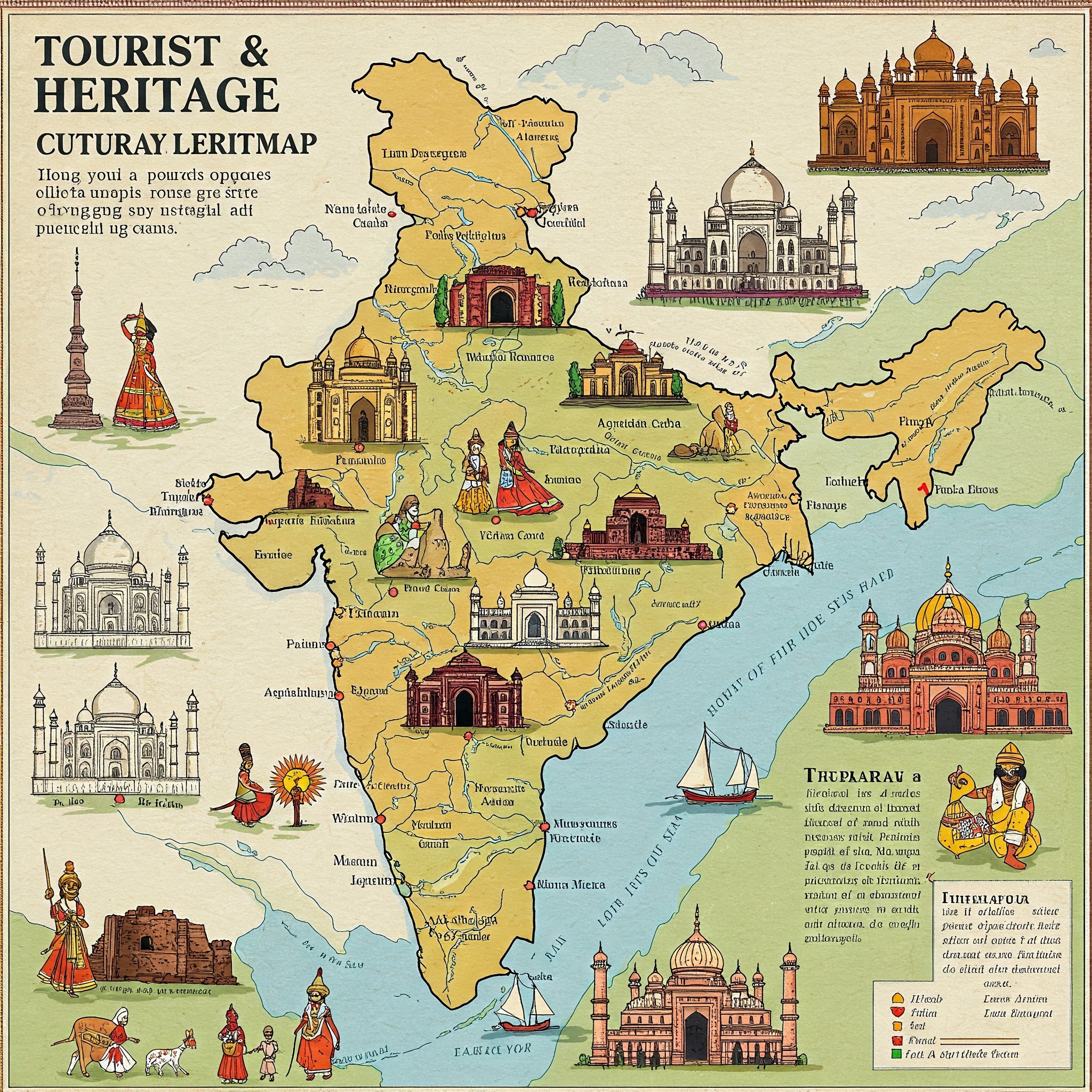
Tourist & Heritage Map Details for India
India's tourism is a confluence of ancient history, spiritual fervor, and ecological diversity. A comprehensive map must detail these layers of attraction, organized by the popular circuits that drive domestic and international travel.
I. The Heritage Heartlands: North and Central India
This region, comprising the capital Delhi, Uttar Pradesh, Rajasthan, and Madhya Pradesh, forms the historical and architectural core of the map.
1. The Golden Triangle & Mughal Legacy (Delhi, Agra, Jaipur)
This is the most crucial circuit, linking three historical capitals:
Delhi (National Capital Territory): A city of layered history, marked by two key UNESCO sites:
Qutub Minar Complex: Featuring the world’s tallest brick minaret, a foundational site of Indo-Islamic architecture.
Humayun's Tomb: The first garden-tomb on the Indian subcontinent, a precursor to the Taj Mahal.
Red Fort Complex: The imperial seat of Mughal power under Shah Jahan.
Agra (Uttar Pradesh): The heart of Mughal opulence.
Taj Mahal (UNESCO Site): The iconic 17th-century white marble mausoleum, a testament to eternal love.
Agra Fort (UNESCO Site): A massive red sandstone fortress that served as the main residence of Mughal emperors.
Fatehpur Sikri (UNESCO Site): Emperor Akbar's short-lived, perfectly preserved imperial capital city, noted for its blend of architectural styles.
Jaipur (Rajasthan - The Pink City): Known for its royal heritage.
Amer Fort: A magnificent hill fort famed for its artistic Hindu style elements.
Jantar Mantar (UNESCO Site): An 18th-century astronomical observation site.
Hawa Mahal (Palace of Winds): Its distinctive honeycomb facade.
2. Central India's Spiritual and Ancient Marvels
Madhya Pradesh: Rich in pre-Mughal history.
Khajuraho Group of Monuments (UNESCO Site): Clusters of Hindu and Jain temples (10th-11th century) renowned for their intricate and often erotic sculptures.
Buddhist Monuments at Sanchi (UNESCO Site): The oldest stone structures in India, preserving early Buddhist art and architecture.
Rock Shelters of Bhimbetka (UNESCO Site): Prehistoric Paleolithic and Mesolithic rock art sites showing the earliest traces of human life on the subcontinent.
Bihar (The Buddhist Circuit): Tracing the life of the Buddha.
Mahabodhi Temple Complex at Bodh Gaya (UNESCO Site): The site where Siddhartha Gautama attained enlightenment under the Bodhi Tree.
Archaeological Site of Nalanda Mahavihara (UNESCO Site): Ruins of one of the world's oldest and greatest universities.
II. South India: Temple Architecture and Tropical Coastlines
The South is defined by Dravidian architecture, colonial history, and unique geographical features.
1. Deccan Plateau and Southern Dynasties
Karnataka: Center of the Vijayanagara and Hoysala Empires.
Group of Monuments at Hampi (UNESCO Site): The stunning ruins of the Vijayanagara Empire capital, set amidst a surreal boulder landscape.
Sacred Ensembles of the Hoysalas (UNESCO Site): Featuring the intricate Chennakeshava Temple at Belur and Hoysaleswara Temple at Halebidu.
Tamil Nadu: Home to the towering Gopuram temples.
Great Living Chola Temples (UNESCO Site): Including the Brihadeeswarar Temple at Thanjavur, masterpieces of Chola architecture and sculpture.
Group of Monuments at Mahabalipuram (UNESCO Site): 7th and 8th-century Pallava dynasty temples and rock-cut structures along the coast.
2. Coastal and Backwater Circuits
Kerala (Backwaters Circuit): Highlighted are the serene network of canals and lakes (Alleppey, Kumarakom) where travelers experience life via houseboats (kettuvallams).
Goa: Famous for its beaches and colonial legacy.
Churches and Convents of Goa (UNESCO Site): Reflecting Portuguese influence, notably the Basilica of Bom Jesus.
Western Ghats (UNESCO Natural Site): The mountain range spanning Maharashtra, Goa, Karnataka, Kerala, and Tamil Nadu, recognized as one of the world's ten hottest biodiversity hotspots.
III. Natural and Wildlife Reserves
A heritage map must clearly delineate major protected areas for eco-tourism:
| Park Name | State | Key Attraction | UNESCO Status |
|---|---|---|---|
| Kaziranga National Park | Assam (Northeast) | One-horned Rhinoceros, Wild Water Buffalo | Natural |
| Sundarbans National Park | West Bengal (East) | Mangrove Forest, Royal Bengal Tiger | Natural |
| Ranthambore National Park | Rajasthan (North) | Bengal Tiger, historical fort ruins | - |
| Gir National Park | Gujarat (West) | Asiatic Lion (the only habitat outside Africa) | - |
| Periyar National Park | Kerala (South) | Elephant, Tiger, diverse ecology | - |
| Valley of Flowers National Park | Uttarakhand (North) | High-altitude alpine flowers | Natural |
IV. Logistical and Geographical Markers
Crucial for travel planning, these details provide the map's navigational layer:
Major Airports: IGI (Delhi), CSMIA (Mumbai), CCU (Kolkata), MAA (Chennai), BLR (Bengaluru) – acting as gateways to the respective regions.
Major Ports/Coastal Cities: Mumbai, Kochi, Chennai, Visakhapatnam.
National Highways: Highlighting the arterial roads (e.g., NH 44, the longest highway).
Mountain Railways (UNESCO Site): Marking the Darjeeling Himalayan Railway (West Bengal), Nilgiri Mountain Railway (Tamil Nadu), and Kalka-Shimla Railway (Himachal Pradesh), showcasing engineering feats in challenging terrains.
Major Rivers: Ganga, Yamuna, Brahmaputra, Narmada, Godavari, and Krishna, which are often pilgrimage or cultural hubs (e.g., Varanasi on the Ganga).